World Pool-Billiards Association Blackball Rules
Download PDF- BLACKBALL
The Game shall be known as 'Blackball' and referred to in these rules as the 'game'. It is intended that players and teams should play Blackball in the true spirit of the game and in a sportsmanlike manner. It should be clearly understood that the referee is the sole judge of what is fair and unfair play. The referee shall take whatever action is necessary to ensure that these rules are observed.
- EQUIPMENT AND TABLE LAYOUT
The game of Blackball Pool is played on a six pocket rectangular Pool table with six cushions and a set of balls consisting of:
- A white ball called the 'cue ball'.
- Two groups of object balls consisting of seven red (or blue) and seven yellow balls. Alternatively use balls numbered 1 to 7 and 9 to 15.
- A black ball (8 ball).
- Mechanical bridges such as spider, goose-neck and cross rests.
- Cues, extender, chalk, gloves and powder.
No other equipment is permitted unless ratified by the WPA.
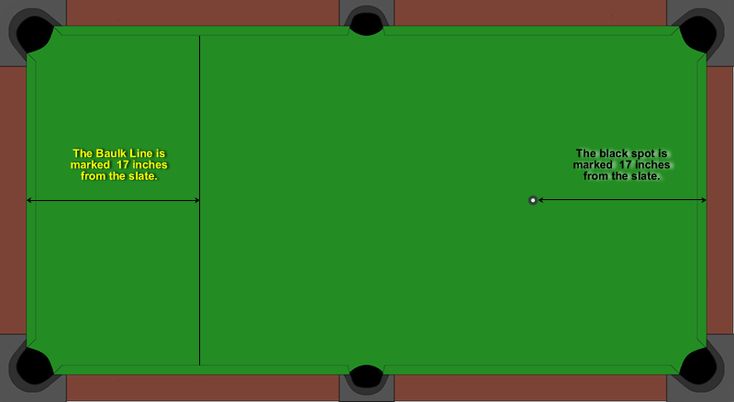
The playing surface is the flat part of the table bordered by cushions. The surface should be marked with a black spot at the intersection of two imaginary diagonal lines joining centre and corner pockets.
The cloth is marked with a baulk line. A straight line drawn from cushion to cushion 1/5th of the length of the table parallel to the face of the cushion which lies at the greatest distance from the black spot.
Baulk is the rectangular area bordered by the baulk line and three cushions.
- OBJECT OF THE GAME
The player or team pocketing their group of object balls in any order and legally pocketing the blackball wins the game.
- COMMENCEMENT OF THE GAME OR A RE-START
The opening break shot is determined by lag. The player winning the lag has the choice of performing the opening break shot or assigning it to the opponent. In any match the lag is performed once only, breaks alternate thereafter. (Exception see rule 8.7.)
The following procedure is used for the lag for the opening break. Each player should use balls of equal size and weight (preferably cue balls, but when not available any two object balls.) With the balls in hand behind the baulk line, one player to the left and one to the right of the table, the balls are shot simultaneously to the top cushion to then return as close as possible to the baulk cushion. The player whose ball is the closest to the edge of the baulk cushion wins the lag.
LAGGING PROCEDURE
Balls should be of equal size and weight.
Ideally use two cue balls, but when unavailable two object balls.
With 'ball in hand' behind the baulk line, one player to the left and one to the right of the table, balls are struck simultaneously towards the top cushion to return as close as possible to the baulk cushion. The player whose ball comes to rest closest to the edge of the baulk cushion wins.
It is automatic loss of lag if a ball ....
- Crosses into the opponent's half of the table
- Fails to contact the top cushion.
- Drops into a pocket.
- Jumps from the table.
- Touches a side cushion.
- Comes to rest on the playing surface within the area of a pocket past the nose of the baulk cushion.
Players will lag again if both players fall victim to automatic loss of lag rules or the referee is unable to determine which ball is closer.
THE RACK
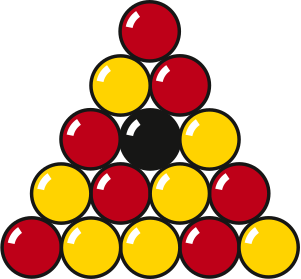
The balls are racked as illustrated with the blackball on the black spot, which is at the intersection of the centre and corner pockets.
THE BREAK
The first shot of a frame is the break. To 'break', the cue ball is played from baulk at the triangle of object balls.
Frames commence when a player’s cue tip contacts the cue ball.
- The break is legal if a ball is potted, OR at least two object balls fully pass an imaginary line joining the middle of the centre pockets.
- If it is an illegal break the opponent is awarded a free shot plus one visit. The cue ball can be played from where it lies OR from baulk OR there is a re-rack.
PLAYING FROM BAULK
Baulk is the rectangular area of the table that is bordered by the baulk line and the three cushions at that end of the table.
- The cue ball must be in baulk when a shot is played. If the centre of the cue ball is on the baulk line this is deemed in baulk.
- The cue ball must be moved only by hand. Not with the shaft of the cue. The player may continue to adjust the position of the cue ball by hand until a shot is played. If the cue ball is touched with the tip of the cue a shot is deemed to have been played and it is a foul if it does not meet the requirements of a legal shot.
- The cue ball may be played in any direction. After a foul, if the player decides to play from baulk, position the cue ball without touching any other ball(s).
It is a foul, if during placement, the cue ball touches another other ball(s).
BLACKBALL BREAKSHOT
If the blackball is potted on any break including a re-rack break, all the balls are re-racked and the same player breaks again. No penalty will be incurred, this applies even if other balls including the cue ball, are pocketed, or leave the playing surface - off the bed of the table.
DECIDING GROUPS
- Groups are never decided on the break.
- Groups can never be decided on a foul.
After the breakoff shot the table is open and the player in control may play a ball(s) from either group. The blackball cannot be used as a 'ball on' to pot any object ball, except after a foul has been committed and the table is open. If the player in control pockets a ball(s) of both groups with the next shot, the table remains open. If the player in control pockets a ball(s) of a single group, the player is on that group of balls. Once groups are decided the player remains on that group for the duration of the frame. The opponent remains on the opposite group for the duration of the frame.
DECIDING GROUPS AFTER A FOUL SHOT
If a foul is committed on an open table and one or more object ball(s) are pocketed, then those balls are ignored in determining the groups to be played and the oncoming player has a free visit playable from were the cue ball stopped or he/she can play from baulk. The incoming player faces an open table.
If a player faces an open table after a foul, the player may play any ball(s) on his/her free shot. After which the table remains open.
CONTINUES PLAY
If a ball(s) are legally pocketed, this entitles the player to one additional shot and this continues until the player either:
- Fails to pocket one of his/her set of allocated balls or
- Commits a foul.
The player in control plays until he/she misses or fouls causing him/her to lose control of the table.
CUE BALL IN HAND
When a player has the cue ball in hand he/she plays from any position within baulk and in any direction. For full details regarding legal placement see rule 4.3.
TOUCHING BALLS
Playing away from a touching object ball 'on'
The instant a player plays away from a touching object ball on, the player is deemed to have played that ball. Therefore, the player needs to then only pot a ball of his/her own group, or cause any ball, including the cue ball, to strike a cushion to fulfil the requirements of a legal shot.
Playing away from a touching object ball 'not on'
The player must play away from the touching ball and then meet all the requirements of a legal shot.
Playing away from two or more touching object balls
The player in control must play away from all touching balls and then meet all the requirements of a legal shot, if unable to do so the game is a stalemate and must be re-racked.
If the cue ball is touching any object ball, the player is obliged to 'play away' from that ball. Should the 'touching' ball move while playing away, this is a foul.
COMBINATION SHOTS (Skill Shots)
- Combination shots are allowed provided that the player contacts one of his/her own group of balls first and pots both his/her ball and the opponents ball in any order.
- A combination shot can include your last object ball(s) and the blackball to win the frame as long as you play your last object ball(s) first and pot both balls.
- A combination shot can include playing the blackball (when the blackball is ball 'on') onto an opponent's object ball(s) and potting both balls.
BALLS OFF THE TABLE
It is a foul if a ball leaves the playing surface, does not return by its own means and remains off the playing surface. (Other than being potted.) If a ball leaves the playing surface and remains off the playing surface, it shall be returned to the table:
- If it is the cue ball it is to be played from baulk;
- If it is an object ball(s) it is to be spotted. (Refer to rule 4.12)
'By its own means'
- It is not a foul if a ball leaves the playing surface, runs along the top of a cushion drops back onto the playing surface and comes to rest there or falls into a pocket.
- It is a foul if a ball leaves the playing surface, comes into contact with a person or object that is not part of the table and then returns to the playing surface.
A ball remaining off the table.
All ball(s) remaining off the bed of the table, i.e. the playing surface, will be returned to the table and re-spotted. (Except where rule 4.12 applies).
RE-SPOTTED BALLS
If it is the cue ball it is to be played from baulk. A ball is spotted when its centre point is placed on the black spot or if this is not possible as near as possible to the spot in a direct line between the spot and the centre point of the cushion which lies the greatest distance from the baulk line. If any of the following balls require spotting they are spotted in the following order.
- Blackball,
- Red (or blue or solid 1-7) balls,
- Yellow (or striped 9-15) balls.
Spotted ball should be placed as close as possible to each other and any intervening balls, without touching each other.
INTERFERENCE
If any balls are moved during a frame:
- By a person other than the players taking part in the frame, or
- As a direct result of one of the players being bumped, or
- Due to any other event deemed outside the player's control.
No penalty will be incurred for the above situations; the referee will try to return the balls to their original positions. (The referee's decision on placement of the ball(s) is final). The referee will prevent any unauthorised marking of the table. A player may not use a block of chalk or other foreign matter as a marker for a shot. It is not a foul to place your chalk on the table while in control, but it should be removed before the opponent addresses the table.
BALL FALLING IN WITHOUT BEING HIT
Ball on Edge of Pocket
- If a ball falls into a pocket without being hit by another ball - after being motionless for five seconds or longer - and being no part of any stroke in progress, it shall be replaced and play shall continue.
- If a ball falls into a pocket 'by itself' during a shot, so that it would have been hit by another ball had that ball still been there, all balls are to be replaced to their positions prior to the stroke. The player may then replay his/her shot, or choose a different shot if he/she wishes.
- If a ball balances momentarily on the edge of a pocket and then falls in; it shall count as in the pocket and not be replaced.
OBJECT BALL FROZEN TO A CUSHION
This rule applies to any shot where the cue ball's first contact with a ball is with one that is frozen to a cushion. After the cue ball makes contact with the frozen object ball, the shot must result in either:
- A ball being pocketed or;
- The cue ball contacting a cushion or;
- The frozen ball being caused to contact a cushion attached to a separate rail or;
- Another object ball being caused to contact a cushion with which it was not already in contact.
Failure to satisfy one of those four requirements is a foul. A ball which is touching a cushion at the start of a shot and then is forced into a cushion attached to the same rail is not considered to have been driven to that cushion unless it leaves the cushion, contacts another ball, and then contacts the cushion again. An object ball is not considered frozen to a cushion unless it is examined and announced as such by either the referee or one of the players prior to that object ball being involved in a shot.
STALEMATE
Should any situation arise whereby a legal shot cannot be played, whether this situation is arrived at by accident or design, the frame shall be restarted. If the re-rack is due to stalemate by accident the same player will break again. If the re-rack is due to slow or negative play (or by design) the players will re-lag to determine who will break. Re-racks may be a reduced number of balls in accordance with competition rules or guidance see 8.7.
WHEN A FRAME OR GAME IS COMPLETED
The game is completed when the blackball is potted during a legal shot and all the remaining balls including the cue ball have come to rest or in a loss of frame situation.
After a player has won a frame or game, the referee must wait for the balls to stop moving and announce, Frame/Game to (Player/province). If the referee has not made the call yet, a player will be penalised by loss of frame if he/she plays a shot, or interferes with any remaining balls (including the cue ball) unless all ball(s) have stopped moving.
SNOOKERS
A player is in a snooker when it is impossible to hit any part of any ball 'on' by way of a straight line shot. In this situation the player need only cause the cue ball to contact a ball 'on', to execute a legal shot.
A player does not have to pot a ball or cause the cue ball or another ball to contact a cushion once he has escaped from the snooker. The player should seek confirmation from his/her opponent, referee or other tournament official if needed.
General
The table will remain open until one of the players legally pockets a ball(s) from a single group of balls, then that group of balls will determine his/her group. If groups have been decided; after a foul the table is deemed open for the free shot only. When 'on' a group of balls, potting more than one ball of that colour in the same shot is legal.
- FOULS
- Potting the cue ball - 'in-off' (also from the break). Following an 'in-off', the player or referee may recover the cue ball from the basket.
- Playing from outside baulk when obliged to play from baulk. The centre point of the cue ball must be in baulk
- Potting an opponent's ball without potting a ball from your own group except when the table is open following a foul.
- Failing to perform a legal shot.
- Cause the cue ball's initial contact with a ball to be a ball 'on', and then pot a ball 'on', except where 6.2 applies OR
- Cause the cue ball or any object ball to contact a cushion. Failure to play a legal shot is a foul except when rule 5.7 applies.
JUMPSHOTS
A jump shot is a foul - causing the cue ball to jump over any ball. (If the cue ball leaves the bed of the table and misses an object ball that would have been struck had the cue ball not left the table on an otherwise identical shot, the cue ball is deemed to have jumped over that object ball).
PUSH STROKES
A push stroke is a foul defined as when the tip of the cue remains in contact with the cue ball once it has commenced its forward motion.
- Striking the cue ball with any part of the cue other than the tip.
- Playing a shot before all balls have come to rest from the previous shot.
- Playing a shot before all balls that require spotting, have been spotted.
- Playing out of turn.
DOUBLE HIT
Causing the cue tip to contact the cue ball more than once in the same shot.
- Playing a shot while not having at least one foot touching the floor. A player must have at least one foot on the floor except were special needs apply (i.e. physical disability or other special needs).
- Players body or part thereof, clothing, jewellery or any accessory or part of a cue touching any ball.
Legal Shot
On all shots, the player must:
A player is responsible for any equipment that they bring to the table other than those supplied by the tournament. Should the end fall off a rest or spider that has been supplied, and contact a ball on the table, this will not be a foul as the player should not suffer any penalty because of faulty equipment. Should it be their own equipment, it will be a foul and normal rules apply.
- PENALTY AFTER A FOUL
- Following any foul the offending player loses his/her next visit to the table, and his/her opponent is entitled to a free shot plus one visit.
- On the first shot only, of his/her free shot, the oncoming player may, without nomination, play the cue ball onto any ball(s) without penalty.
- The player can play or pot any of the opponent's ball(s). (The table is deemed open for the free shot only).
- The player can play a combination shot by playing their opponent's ball(s) and pot his/her own group of balls or play his/her ball 'on' and pot his/her opponent's ball(s).
- The player can play the blackball and pot his/her opponent's ball(s) or pot a ball(s) of his/her own group of balls.
- The blackball may be played but not potted unless it is ball 'on' (rule 4.10 applies).
- Following any foul, the cue ball may be returned to baulk or played from where it lies on the bed of the table and proceed as rule 6(a) and 6(b). The player has the option of playing the cue ball from baulk. Moving the cue ball in this manner does not count as a shot or visit.
The free shot: (After a foul)
- LOSS OF FRAME FOULS
- Committing a foul in the same shot that the blackball is potted.
- Potting the blackball when a ball(s) of the player's own group are still on the table.
DELIBERATE FOUL
A player who clearly and intentionally plays a ball not 'on' will have committed a deliberate foul resulting in loss of frame.
A player who clearly and intentionally fails to make an attempt to play a ball(s) of his/her own group will lose the frame.
Failing to make a bona fide attempt to play a legal shot will be deemed to be a Deliberate foul and will result in loss of frame.
- The referee is the only person who can deliberately touch any ball on the bed of the table, including the cue ball after a foul. (If a referee is not available then the player must ask his/her opponent to pick up the cue ball from any position on the bed of the table.)
If a player picks up any ball without permission, he/she will lose the frame.
CATCHING OR PREVENTING A BALL FROM GOING 'IN-OFF'
If the cue ball is in the progress of going 'in-off' and the player catches the cue ball, preventing it from going into the pocket and through the table mechanism, then it is LOSS OF FRAME.
- Deliberately interfering, by word or action, so as to disrupt an opponent's play.
- GENERAL TOURNAMENT AND LEAGUE GUIDELINES (PLAYING WITH A REFEREE)
TIME FOUL
A player has a maximum of 60 seconds to play each shot, including the break and 'ball in hand'. The referee will start timing when all balls have come to rest from the previous shot.
If a player has not played a shot within 60 seconds, it is a foul and the opposing player will be awarded a free shot plus one visit.
If the first thirty seconds elapses before a player has played his/her shot, the referee will announce: 'Thirty seconds' as a warning to the player. The call must be made the instant the thirty seconds has expired. The referee should not postpone the call because it appears that the player is about to play a shot, even if it means speaking while a player is addressing the cue ball. Following an 'in-off', the player or referee may recover the cue ball from the basket. If the player takes his/her time in recovering the cue ball, the referee will recover the cue ball and hand it to the player who is in control of the table. As soon as the cue ball is handed to the player, or the player recovers the cue ball himself/herself, the referee will start timing and the player has a maximum of 60 seconds to play his/her shot.
A 'Time Out' may be called for the following reasons the referee must use his/her discretion and this call must be made loud enough so that both players can hear the call
- A player requests a rest/bridge.
- Something is obstructing the player.
- A 'touching ball' decision.
UNSPORTSMANLIKE CONDUCT
If the player breaches the 'Spirit of the Game' to such an extent that the frame (or match) should be awarded to the opponent.
GUIDELINES ON UNSPORTSMANLIKE CONDUCT
- Foul language;
- Player throwing his/her cue around or unscrewing it as if to concede.
- Arguing with an opponent, spectator or referee.
- Continuously disagreeing with the referee's decision and/or ruling.
- Interfering while your opponent is playing his/her shot.
- At the end of your visit not moving away from the table and out of your opponent's way, will be considered unsportsmanlike behaviour.
COACHING
During a frame, a player is required to play without receiving any advice from other persons relating to the playing of the frame. If, in the opinion of the referee, the outcome of the frame has been compromised, the referee may decide to award the frame to the opponent.
The referee should in all cases see that the game is played in a fair and just manner.
LEAVING THE PLAYING AREA
If a player needs to leave the playing area during a match, the player must have the referees' permission. A player must never leave the playing area during a frame unless exceptional circumstances apply, and the tournament director has been advised before the match begins.
If the match isn't refereed players should only take necessary bathroom breaks between frames.
- A referee may, if requested, advise on the rules of the game.
When asked for a clarification of a rule, the referee will explain the applicable rule to the best of his ability. The referee must not offer or provide any subjective opinion that would affect play, such as whether a legal shot can be played on a prospective shot. The referee will not be held responsible for incorrect information as it is the players duty to know the rules of the game.
- The referee should ensure that excessive time is not taken to play a shot and should act in accordance with competition rules or guidance.
This is required for when an event doesn't use the time rule in 8.1.
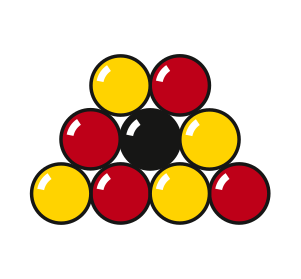
9 BALL RE-RACKS
9 ball re-racks following slow or negative play. Rack the 15 balls as normal and then remove the top ball and the back five as pictured below. The players must also re-lag to determine who will break in this situation.
- In doubles matches once a player has approached the table, conversation with others including the partner, is unsporting and shall be dealt with under competition rules.
PLAYING WITHOUT A REFEREE
When a referee is not available, any dispute between two players should immediately be referred to the Tournament Director or an appointed substitute. Play must stop to allow the official to be called as any protest must be made immediately and prior to any subsequent shot being taken, or it cannot be considered or honoured. If the player fails to do so, the foul is considered not to have occurred.
All players must honour an opponent's request that play be halted if an official is to be summoned or if a referee is to check or verify a rule question with other officials. Failure to honour such requests may result in disqualification or forfeiture of the game or match under the provisions of 'Unsportsmanlike Conduct'